Last year I only read one writing book. (It was a hard reading year.) For 2023, I’m aiming to spend less time scrolling and more time reading, and I’m hopeful I’ll finish at least a few craft books and related nonfiction titles along the way. Here’s a look at what’s on my TBR.
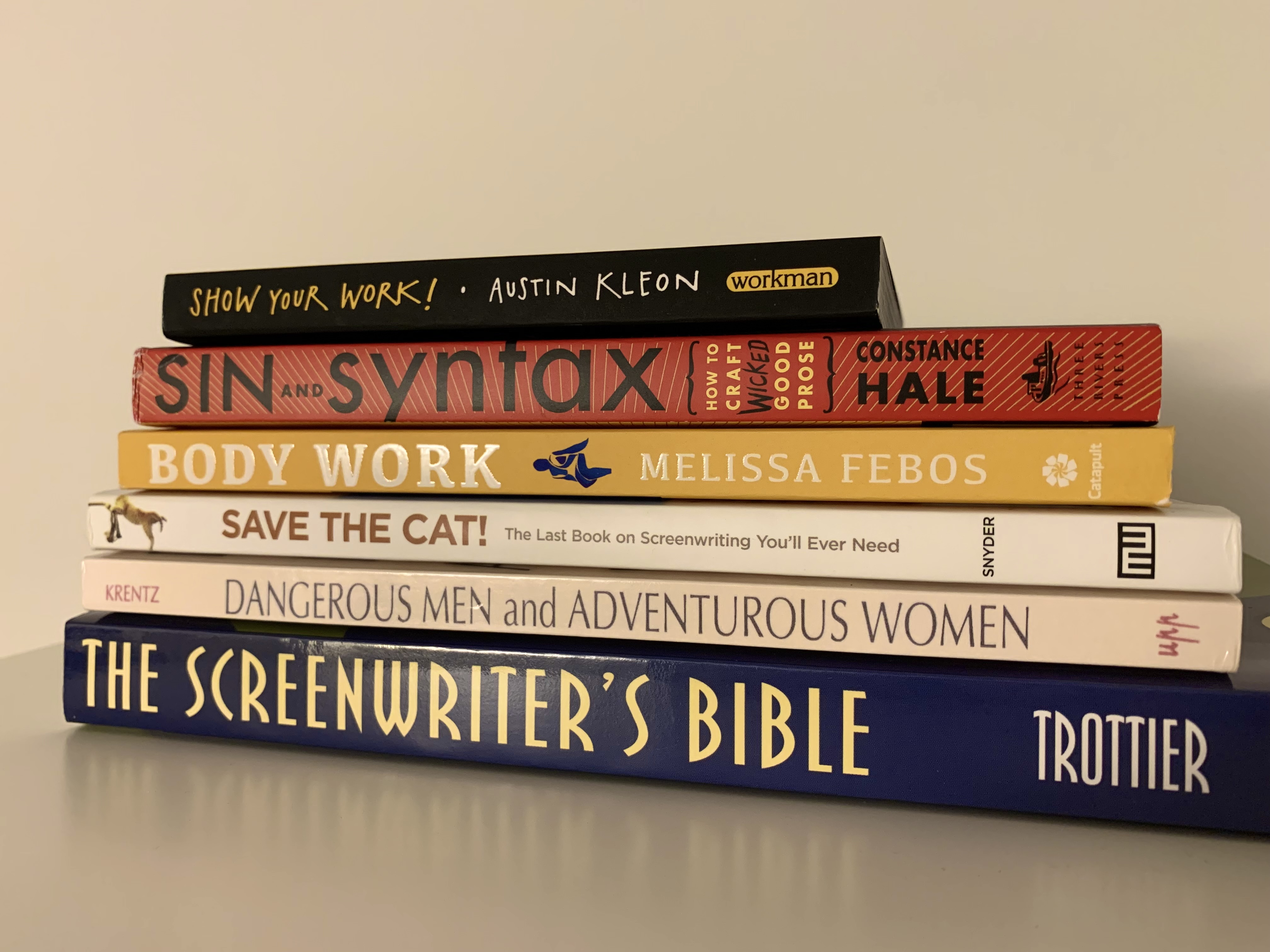
Show Your Work: 10 Ways to Share Your Creativity and Get Discovered by Austin Kleon
Sin and Syntax: How to Craft Wicked Good Prose by Constance Hale
Save the Cat! The Last Book on Screenwriting You’ll Ever Need by Blake Snyder
Dangerous Men and Adventurous Women: Romance Writers on the Appeal of the Romance edited by Jayne Ann Krentz
The Screenwriter’s Bible by David Trottier
Writing the Romantic Comedy: The Art of Crafting Funny Love Stories for the Screen by Billy Mernit
Screenwriting 101: Mastering the Art of Story by Angus Fletcher
Write True: A Bestseller’s Guide to Writing Craft and Achieving Success in the Romance Industry by Jennifer Probst
Body Work: The Radical Power of Personal Narrative by Melissa Febos
How to Read Now: Essays by Elaine Castillo
The Anatomy of a Best Seller by Sacha Black
Breaking the Good Girl Myth: How to Dismantle Outdated Rules, Unleash Your Power, and Design a More Purposeful Life by Majo Molfino
Intimations: Six Essays by Zadie Smith
Have you read any of these? What did you think?
 Books on writing craft aren’t for everyone, which is totally fine. I happen to get a lot out of them, but m
 According to Wikipedia, the maximum word count for a novella is 40,000 words*. By contrast, my full-length novels are over 90,000. That’s more than twice as many words! Some authors excel at writing novellas, but if you’re like me and used to writing long, how do you cram a full romance into a smaller package? Well, I do it with a little planning.
 Alexis Daria